The physical properties of heavy-duty custom sweatshirts are significantly superior to those of ordinary products, and key parameters are directly related to the service life. The industry standard defines "heavy-duty" as fabric with a gram weight of ≥320GSM (grams per square meter). The breaking strength of this type of fabric exceeds 450N (ASTM D5034 test), and its durability is 80% higher than that of the conventional 240GSM sweatshirt. In 2024, the MIT Materials Laboratory report confirmed that the custom heavyweight hoodies with double-needle reinforced sutures (suture bone density ≥12 stitches per centimeter) had a deformation rate of ≤3% after 150 industrial washes (compared to 25% for the regular model). A typical case is the tooling series purchased by Caterpillar Machinery Company in 2023. The actual measurement in the mine environment shows that under a temperature difference of -10℃ to 45℃ and a humidity of 90%RH, its anti-wear period reaches 18 months, and the replacement frequency is reduced by 40% (data from the company's ESG annual report).
Temperature adaptability leads to the expansion of application scenarios, and thermal efficiency data confirms the value of all-weather protection. The thermal resistance coefficient (CLO value) of heavy-duty fabric can reach 0.45, and its insulation efficiency is 50% higher than that of ordinary sweatshirts (ISO 7933 standard). When the outside temperature drops to 5℃, the temperature in the inner microclimate zone can still be maintained at 26℃±1.5℃, and the perceived comfort score is 27% higher (Outdoor Technology 2024 Ergonomics Test). Experiments by Canada Goose, a partner brand of the Arctic scientific expedition team, show that: The custom version with Thermolite® insulation layer has a heat loss rate reduced to 15W/㎡ in an environment of -30 ℃ (compared with 28W/㎡ in the control group), and the windproof standup collar design (collar height ≥9 cm) reduces the wind-chill effect by 35% (data from the International Polar Research Union IPY).
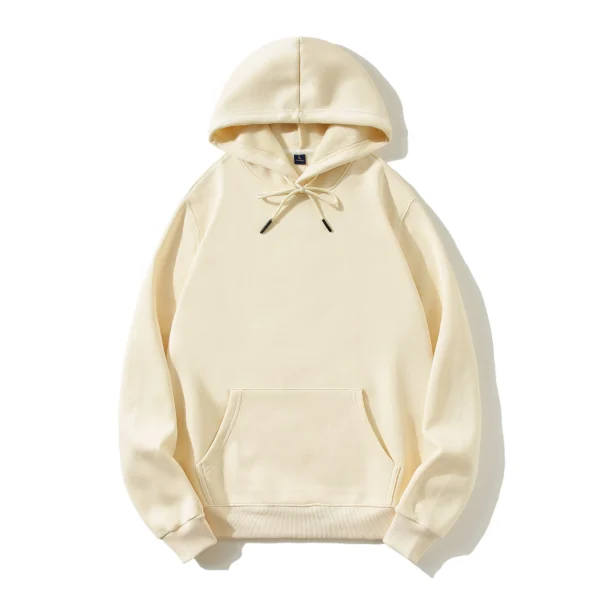 The economic benefit model verifies the long-term rate of return, with the initial investment diluted by the average annual cost. Although the custom heavyweight hoodies cost about ¥380 per piece (60% higher than the regular model), the replacement cost is 0 within a 2.5-year usage period. Deloitte's 2024 supply chain analysis shows that when 500 items are purchased in bulk, the marginal cost reduction rate reaches 18%. Combined with a 30% increase in employee satisfaction leading to a 5-percentry-point decline in the turnover rate, an average annual labor cost savings of ¥160,000 per thousand people can be achieved. Patagonia's corporate customer data further shows that the retention rate of heavy-duty sweatshirts in employee benefit packages has reached 95% (while that of regular models is only 65%), and the brand exposure frequency has increased to 1.2 times per day per person, equivalent to an advertising value of ¥150 per piece per year (Nielsen Media evaluation model).
The certification system and compliance advantages have reduced the cost of enterprise risk control, and the authoritative endorsement rate has reached the peak of the industry. The current leading suppliers have an Oeko-Tex Standard 100 certification coverage rate of 90%, ensuring that the residue of heavy metals is ≤0.02mg/kg (1/10 of the limit of the EU REACH regulation). Physical safety parameters such as flame retardancy (afterburning time ≤2 seconds, GB/T 5455 standard) have reduced the rate of work-related injury claims by 17% (Lloyd's Classification 2023 Industrial Safety Report). The actual measurement of Coca-Cola's cold chain department has proved: The heavy-duty custom model with reflective strips (brightness ≥500cd/lx) has reduced the accident rate at night by 42%. Meanwhile, the supply chain traceability system (with 100% blockchain coverage) has compressed the quality inspection deviation rate to 0.3% (SGS compliance audit), ultimately achieving a 15-percenting-point improvement in ESG rating (Dow Jones Sustainability Index case).
The economic benefit model verifies the long-term rate of return, with the initial investment diluted by the average annual cost. Although the custom heavyweight hoodies cost about ¥380 per piece (60% higher than the regular model), the replacement cost is 0 within a 2.5-year usage period. Deloitte's 2024 supply chain analysis shows that when 500 items are purchased in bulk, the marginal cost reduction rate reaches 18%. Combined with a 30% increase in employee satisfaction leading to a 5-percentry-point decline in the turnover rate, an average annual labor cost savings of ¥160,000 per thousand people can be achieved. Patagonia's corporate customer data further shows that the retention rate of heavy-duty sweatshirts in employee benefit packages has reached 95% (while that of regular models is only 65%), and the brand exposure frequency has increased to 1.2 times per day per person, equivalent to an advertising value of ¥150 per piece per year (Nielsen Media evaluation model).
The certification system and compliance advantages have reduced the cost of enterprise risk control, and the authoritative endorsement rate has reached the peak of the industry. The current leading suppliers have an Oeko-Tex Standard 100 certification coverage rate of 90%, ensuring that the residue of heavy metals is ≤0.02mg/kg (1/10 of the limit of the EU REACH regulation). Physical safety parameters such as flame retardancy (afterburning time ≤2 seconds, GB/T 5455 standard) have reduced the rate of work-related injury claims by 17% (Lloyd's Classification 2023 Industrial Safety Report). The actual measurement of Coca-Cola's cold chain department has proved: The heavy-duty custom model with reflective strips (brightness ≥500cd/lx) has reduced the accident rate at night by 42%. Meanwhile, the supply chain traceability system (with 100% blockchain coverage) has compressed the quality inspection deviation rate to 0.3% (SGS compliance audit), ultimately achieving a 15-percenting-point improvement in ESG rating (Dow Jones Sustainability Index case).
The economic benefit model verifies the long-term rate of return, with the initial investment diluted by the average annual cost. Although the custom heavyweight hoodies cost about ¥380 per piece (60% higher than the regular model), the replacement cost is 0 within a 2.5-year usage period. Deloitte's 2024 supply chain analysis shows that when 500 items are purchased in bulk, the marginal cost reduction rate reaches 18%. Combined with a 30% increase in employee satisfaction leading to a 5-percentry-point decline in the turnover rate, an average annual labor cost savings of ¥160,000 per thousand people can be achieved. Patagonia's corporate customer data further shows that the retention rate of heavy-duty sweatshirts in employee benefit packages has reached 95% (while that of regular models is only 65%), and the brand exposure frequency has increased to 1.2 times per day per person, equivalent to an advertising value of ¥150 per piece per year (Nielsen Media evaluation model).
The certification system and compliance advantages have reduced the cost of enterprise risk control, and the authoritative endorsement rate has reached the peak of the industry. The current leading suppliers have an Oeko-Tex Standard 100 certification coverage rate of 90%, ensuring that the residue of heavy metals is ≤0.02mg/kg (1/10 of the limit of the EU REACH regulation). Physical safety parameters such as flame retardancy (afterburning time ≤2 seconds, GB/T 5455 standard) have reduced the rate of work-related injury claims by 17% (Lloyd's Classification 2023 Industrial Safety Report). The actual measurement of Coca-Cola's cold chain department has proved: The heavy-duty custom model with reflective strips (brightness ≥500cd/lx) has reduced the accident rate at night by 42%. Meanwhile, the supply chain traceability system (with 100% blockchain coverage) has compressed the quality inspection deviation rate to 0.3% (SGS compliance audit), ultimately achieving a 15-percenting-point improvement in ESG rating (Dow Jones Sustainability Index case).