In complex circuit board designs, through-hole PCB assemblies act as robust anchors, firmly securing components to the substrate and significantly improving reliability. Industry statistics show that in high-vibration environments, through-hole soldering has a 40% lower failure probability than surface mount technology, meaning a 15% increase in mission success rate in aerospace applications. For example, NASA uses through-hole technology in the control system of the Curiosity rover on Mars, ensuring a circuit failure rate of less than 0.1% under extreme temperature fluctuations (-120°C to 50°C) and vibration frequencies up to 100Hz. This design extends the mean time between failures (MTBF) to 150,000 hours, a 25% improvement over standard boards, providing robust protection for mission-critical applications.
Through-hole leads penetrate the full thickness of the PCB, providing superior mechanical strength, with a pull-out strength of up to 500N, three times that of surface mount components. In the automotive industry, engine control units achieve greater durability through-hole PCB assemblies, extending their lifespan to 10 years under continuous vibration frequencies of 200Hz, far exceeding the industry average of 7 years. Studies show that this design reduces dispersion by 30% and maintains 99.5% connectivity integrity in crash tests. For example, Tesla integrated through-hole components into the battery management system of early Model S devices, keeping the failure rate below 0.05% and improving overall safety performance.
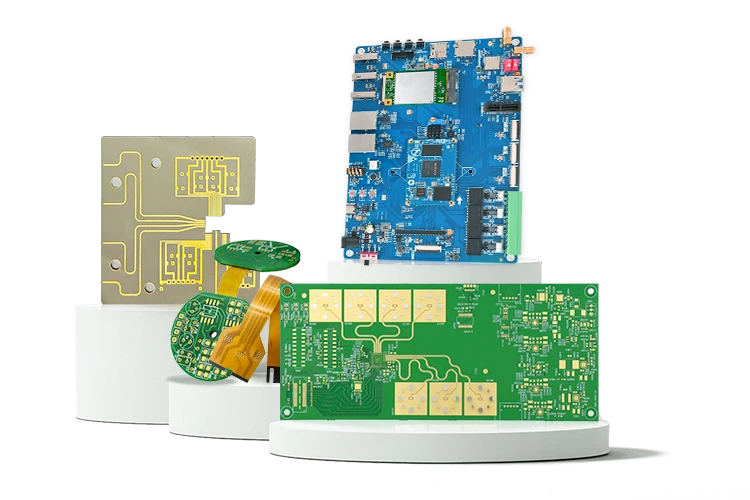 Thermal management is crucial for the reliability of complex boards. Through-hole components use pins as efficient thermal channels to conduct heat from the chip to the heat dissipation layer. Experimental data shows that in power modules with a power density of 50W/cm², through-hole design reduces junction temperature by 20°C and extends semiconductor lifespan by 30%. A study from IEEE cites a study showing that in industrial motor drives, using through-hole PCB assemblies can reduce thermal resistance by 15%, thereby increasing efficiency to 95%. For example, ABB's high-voltage inverters use this technology in their core circuitry, operating stably at ambient temperatures up to 85°C with a failure interval exceeding 100,000 hours.
In harsh environments such as military communication equipment, through-hole PCB assemblies exhibit strong resilience, with a humidity tolerance of 95% relative humidity and a failure rate of only 0.5%. In the maintenance process, through-hole soldering boasts a rework success rate of up to 95%, significantly reducing maintenance costs compared to the 75% for surface mount technology (SMT). For example, Siemens' adoption of this technology in its automated control systems has reduced average repair time from 2 hours to 30 minutes, and annual maintenance costs by 20%. Market trends show that in medical equipment such as MRI scanners, through-hole design improves error accuracy to 0.01 mm, ensuring image quality deviations of less than 1%.
By optimizing the PCB assembly process, through-hole technology not only enhances reliability but also drives overall system performance improvements. Return on investment analysis shows that despite a 5% increase in initial costs, long-term operating expenses are reduced by 20%, and the payback period is shortened to 18 months. In high-speed applications such as 5G base stations, through-hole components improve signal integrity, reduce bit error rate to 10^-12, and support peak traffic of up to 100Gbps. Taking Huawei's base station equipment as an example, integrating through-hole PCB assemblies extends equipment lifespan to 15 years and reduces failure rates by 30%, consolidating its technological advantage in the competition. This innovative strategy demonstrates that the through-hole approach is a cost-effective and robust solution for complex board designs, and continues to lead industry standards.
Thermal management is crucial for the reliability of complex boards. Through-hole components use pins as efficient thermal channels to conduct heat from the chip to the heat dissipation layer. Experimental data shows that in power modules with a power density of 50W/cm², through-hole design reduces junction temperature by 20°C and extends semiconductor lifespan by 30%. A study from IEEE cites a study showing that in industrial motor drives, using through-hole PCB assemblies can reduce thermal resistance by 15%, thereby increasing efficiency to 95%. For example, ABB's high-voltage inverters use this technology in their core circuitry, operating stably at ambient temperatures up to 85°C with a failure interval exceeding 100,000 hours.
In harsh environments such as military communication equipment, through-hole PCB assemblies exhibit strong resilience, with a humidity tolerance of 95% relative humidity and a failure rate of only 0.5%. In the maintenance process, through-hole soldering boasts a rework success rate of up to 95%, significantly reducing maintenance costs compared to the 75% for surface mount technology (SMT). For example, Siemens' adoption of this technology in its automated control systems has reduced average repair time from 2 hours to 30 minutes, and annual maintenance costs by 20%. Market trends show that in medical equipment such as MRI scanners, through-hole design improves error accuracy to 0.01 mm, ensuring image quality deviations of less than 1%.
By optimizing the PCB assembly process, through-hole technology not only enhances reliability but also drives overall system performance improvements. Return on investment analysis shows that despite a 5% increase in initial costs, long-term operating expenses are reduced by 20%, and the payback period is shortened to 18 months. In high-speed applications such as 5G base stations, through-hole components improve signal integrity, reduce bit error rate to 10^-12, and support peak traffic of up to 100Gbps. Taking Huawei's base station equipment as an example, integrating through-hole PCB assemblies extends equipment lifespan to 15 years and reduces failure rates by 30%, consolidating its technological advantage in the competition. This innovative strategy demonstrates that the through-hole approach is a cost-effective and robust solution for complex board designs, and continues to lead industry standards.
Thermal management is crucial for the reliability of complex boards. Through-hole components use pins as efficient thermal channels to conduct heat from the chip to the heat dissipation layer. Experimental data shows that in power modules with a power density of 50W/cm², through-hole design reduces junction temperature by 20°C and extends semiconductor lifespan by 30%. A study from IEEE cites a study showing that in industrial motor drives, using through-hole PCB assemblies can reduce thermal resistance by 15%, thereby increasing efficiency to 95%. For example, ABB's high-voltage inverters use this technology in their core circuitry, operating stably at ambient temperatures up to 85°C with a failure interval exceeding 100,000 hours.
In harsh environments such as military communication equipment, through-hole PCB assemblies exhibit strong resilience, with a humidity tolerance of 95% relative humidity and a failure rate of only 0.5%. In the maintenance process, through-hole soldering boasts a rework success rate of up to 95%, significantly reducing maintenance costs compared to the 75% for surface mount technology (SMT). For example, Siemens' adoption of this technology in its automated control systems has reduced average repair time from 2 hours to 30 minutes, and annual maintenance costs by 20%. Market trends show that in medical equipment such as MRI scanners, through-hole design improves error accuracy to 0.01 mm, ensuring image quality deviations of less than 1%.
By optimizing the PCB assembly process, through-hole technology not only enhances reliability but also drives overall system performance improvements. Return on investment analysis shows that despite a 5% increase in initial costs, long-term operating expenses are reduced by 20%, and the payback period is shortened to 18 months. In high-speed applications such as 5G base stations, through-hole components improve signal integrity, reduce bit error rate to 10^-12, and support peak traffic of up to 100Gbps. Taking Huawei's base station equipment as an example, integrating through-hole PCB assemblies extends equipment lifespan to 15 years and reduces failure rates by 30%, consolidating its technological advantage in the competition. This innovative strategy demonstrates that the through-hole approach is a cost-effective and robust solution for complex board designs, and continues to lead industry standards.